.
Jan. 1, 1788 - Jul. 4, 1872
When about twenty-five years old he married Betsy Quimby, of Essex county, Vermont, who bore him ten children -- four sons and six daughters. He moved with his family to Onondago county, New York, and there heard of the gospel being revealed to Joseph Smith. In the winter of 1830-31 he left his home and traveled on horseback to see the Prophet Joseph, who then resided at Fayette, Seneca, New York. After having an interview with the Prophet, he was baptized and became an honorable member of the Church. His wife and those of his children who were old enough also embraced the gospel about the same time. April 16, 1836, in Kirtland, Ohio, where the main body of the Church was then in conference assembled, he received a license to preach the gospel, having previously been ordained an Elder. Subsequently, he removed to Missouri, where he shared with the Saints in their persecutions, and afterward located temporarily in Warsaw, Illinois.
About the year 1840 he removed to Nauvoo, where he served as a captain of police. In times of imminent danger and persecutions he acted as special guard around the person of the Prophet Joseph. On several occasions he was on duty without intermission, for many days and nights, without sleep or rest. His love for the Prophet was so great that he would have given his own life freely in defense of his beloved friend and brother.
On one occasion, when the Prophet had been forewarned that he was in danger, he sent for Brother Roundy and told him to pick a trusty man to be on guard with him at his house, as a party was coming that night by water to kidnap him. Brother Roundy selected Josiah Arnold and placed him on guard at the gate, with orders to admit no one, while he himself took his beat by the river, but on hearing a noise he hastily repaired to the gate and found William Law inside the gate and others in the act of entering. Brother Roundy, who had a hickory walking cane in his hand, quickly took hold of it at each end, and pressing it against the men forced them back outside, and then fastened the gate. William Law endeavored to explain that the men who were with him were gentlemen merchants, who wanted to see the mummies that Joseph Smith had purchased from Michael Chandler. Brother Roundy replied that if they were gentlemen they should come at gentlemen's hours. William Law insisted that Brother Joseph would admit them, as they would pay $10 in pocket money, there being about forty of them; the admission fee was 25 cents for each. On their agreeing not to try to enter while he was gone, Brother Roundy went to Joseph's room. The Prophet, who had overheard the conversation, told Elder Roundy to go back and tell the strangers as a message from him what he (Roundy) had already told them himself. Thus was the Prophet's life and property preserved by the courage and fidelity of Elder Roundy and his associate.
Elder Roundy came to Great Salt Lake valley as one of the pioneers of 1847, and was one of the three men who plowed the first furrow in Great Salt Lake valley. He was a member of the first High Council in the Salt Lake Stake of Zion, and also a member of the first Territorial legislature. He crossed the plains five times to bring poor emigrants to the Valley, was a captain of the "Silver Greys," and one of the first settlers in the 16th ward, where he presided as Bishop from April 14, 1849, until 1856. He had previously been called to the Bishopric by revelation (D&C Sec. 124, Verse 141). Bishop Roundy died a true and faithful member of the Church.
Biography from Tracy Stocking
Photo of grave marker stolen from Findagrave.com until I can get out and take my own photo.
Grave marker and map to follow.
Thursday, April 19, 2012
Tuesday, February 28, 2012
Alma Bailey Dunford
.
Alma Bailey Dunford was born in Trowbridge,Wiltshire , England on August 19, 1850, son of Isaac and Leah Bailey Dunford. In 1853 his parents brought him to America and settled in St. Louis . In 1856, this family came to Salt Lake City , but were soon afterwards called to settle Bear Lake County , Idaho . In 1864, A.B. Dunford came to Salt Lake City to live and has ever since counted this city his home.
Alma was married to Susan Young, daughter of Brigham and Lucy Bigelow Young, on December 1, 1872. They had two children, Leah Eudora , born February 24, 1874, and Alma Bailey, Jr., born August 13, 1875. In early 1877 Alma was called to serve a mission in England and made arrangements for “Susie” and the children to spend time with Alma ’s family. Two weeks later Brigham Young died, and shortly after that Susie wrote to Alma saying that she no longer loved him and wanted a divorce. Alma returned home from his mission and in August of 1879 he reopened his dental office.
Alma Bailey Dunford was born in Trowbridge,
Almost immediately upon his arrival in Salt Lake City , he began to study his dentistry with late Dr. W.W.H.H. Sharp. In his profession, Dr. Dunford developed almost marvelous skill and soon became not only Dr. Sharp’s partner but the most trusted of Utah ’s early dentists. He made many trips from St. George to Bear Lake , carrying his instruments in his buggy and waiting on his patients in the pioneer settlements.
On February 27, 1882 Alma married Lovinia Tricilla Clayton, a daughter of William and Margaret Moon Clayton. They had eight children, two of whom died before adulthood.
Sunday, October 9, 2011
Additional Help needed
Despite my best intentions, I just don't have the time to complete this blog as often as I'd like. If any of my readers would be interested in co-authoring this blog, please shoot me an email. Thanks!
Saturday, March 26, 2011
Archibald Gardner
.
Archibald, born in Scotland, immigrated to Canada as a young man. There he built his first mill. There he met and married his first wife, Margaret. Together, they traveled with Utah's early pioneers, crossing the plains from Missouri River to the Great Salt Lake Valley, arriving there in 1847.
In his lifetime, he built more than 36 mills, as well as canals and bridges. He was also instrumental in the building of the Salt Lake Temple. Gardner provided the valley with valuable irrigation water through his canals.
In 1858, in the face of the threat of Johnston's Army and the Utah War in the Valley, he and his family moved to Spanish Fork, consisting of nine wives, fifteen children, seven step-children and an adopted Indian girl, Fanny. Archibald left behind a homestead at Mill Creek, the mills in the canyon above, a grist mill and carding machine on the Big Cottonwood stream, a grist mill and saw mill on the Jordan River, and the "big hay field" of about 1,000 acres in the river bottoms in the southern end of Salt Lake Valley. Archie began to build a large home for his family in Spanish Fork. However, in 1859, he was called to return to the Valley as bishop of the West Jordan Ward, a position he held for 32 years being released in May of 1891.
Archibald built the original mill in West Jordan in 1853. In 1877 the mill was dismantled and moved to Fairfield. Archibald then built what he referred to as a "bigger and better" mill on the West Jordan site, with a stone basement. Surrounded by a mattress factory, a broom factory and a blacksmith shop, the flour mill became the center of activity in the area. A general store was located just west of the mill (where the Gardner Monument now stands) and supplied goods to settlers from miles around.
He also built the Red Rock Church, which is still standing, near his mill starting construction in 1861. People were poor, and when it was ready for roofing, the money was gone. It was decided to hold a ball as a fund raiser. A tarp was stretched overhead and officers from Fort doublas arrived in uniform adding a military touch. Many church officials were present including President Brigham young and George Q. Cannon. The church was completed in 1867.
Archibald served two terms in the territorial legislature and was also instrumental in the discover of ore in the area. The first location claim in Bingham Canyon is signed by Gardner, Ogilvie and others. The document is dated Bingham Kanyon, Sept 17, 1863.
In 1886 he spent several months in Mexico to escape the federal marshals, who were on the trail of polygamists. In 1889 he moved to Star Valley, Wyoming, to escape the persecution. From this time his family were spread across three locations - Spanish Fork, Utah; West Jordan, Utah; and Afton, Wyoming.
Each of Archibald's wives had a home and acreage in West Jordan. Some of those houses are still standing. There are more than 20,000 descendants of Archibald and wives, living in every state except Delaware and in 22 countries.
Excerpts from Eagle Newspapers, 17 Nov 1994 by Olga Milius
Archibald Gardner was one of Utah's earliest entrepreneurs, made history in the state of Utah as a mill builder, canal builder, irrigation developer, bridge builder, bishop and as husband to 11 wives, father of 48 children and grandfather to 201.
Archibald, born in Scotland, immigrated to Canada as a young man. There he built his first mill. There he met and married his first wife, Margaret. Together, they traveled with Utah's early pioneers, crossing the plains from Missouri River to the Great Salt Lake Valley, arriving there in 1847.
In his lifetime, he built more than 36 mills, as well as canals and bridges. He was also instrumental in the building of the Salt Lake Temple. Gardner provided the valley with valuable irrigation water through his canals.
In 1858, in the face of the threat of Johnston's Army and the Utah War in the Valley, he and his family moved to Spanish Fork, consisting of nine wives, fifteen children, seven step-children and an adopted Indian girl, Fanny. Archibald left behind a homestead at Mill Creek, the mills in the canyon above, a grist mill and carding machine on the Big Cottonwood stream, a grist mill and saw mill on the Jordan River, and the "big hay field" of about 1,000 acres in the river bottoms in the southern end of Salt Lake Valley. Archie began to build a large home for his family in Spanish Fork. However, in 1859, he was called to return to the Valley as bishop of the West Jordan Ward, a position he held for 32 years being released in May of 1891.
Archibald built the original mill in West Jordan in 1853. In 1877 the mill was dismantled and moved to Fairfield. Archibald then built what he referred to as a "bigger and better" mill on the West Jordan site, with a stone basement. Surrounded by a mattress factory, a broom factory and a blacksmith shop, the flour mill became the center of activity in the area. A general store was located just west of the mill (where the Gardner Monument now stands) and supplied goods to settlers from miles around.
He also built the Red Rock Church, which is still standing, near his mill starting construction in 1861. People were poor, and when it was ready for roofing, the money was gone. It was decided to hold a ball as a fund raiser. A tarp was stretched overhead and officers from Fort doublas arrived in uniform adding a military touch. Many church officials were present including President Brigham young and George Q. Cannon. The church was completed in 1867.
Archibald served two terms in the territorial legislature and was also instrumental in the discover of ore in the area. The first location claim in Bingham Canyon is signed by Gardner, Ogilvie and others. The document is dated Bingham Kanyon, Sept 17, 1863.
In 1886 he spent several months in Mexico to escape the federal marshals, who were on the trail of polygamists. In 1889 he moved to Star Valley, Wyoming, to escape the persecution. From this time his family were spread across three locations - Spanish Fork, Utah; West Jordan, Utah; and Afton, Wyoming.
Each of Archibald's wives had a home and acreage in West Jordan. Some of those houses are still standing. There are more than 20,000 descendants of Archibald and wives, living in every state except Delaware and in 22 countries.
Excerpts from Eagle Newspapers, 17 Nov 1994 by Olga Milius
Friday, December 17, 2010
Hey, merry Christmas, everyone.
I've already written down daily blogging in my New Year's resolutions. So more items of interest are yet to come!
Friday, November 26, 2010
Jonathan Golden Kimball
.
One of the most colorful and beloved of the General Authorities of The Church of Jesus Christ of Latter-day Saints was one of the First Seven Presidents of Seventies.
A native of Salt Lake City and son of LDS apostle Heber C. Kimball and Christeene Golden Kimball, J. Golden served as a missionary in the southern United States in 1883, spending part of his service in the area that includes present-day Buena Vista. Despite facing many hardships, serving at a time when anti-Mormon sentiment was strong in the South and when the missionaries were often subject to persecution and even violence, he served faithfully until he was honorably released in the spring of 1885.
He became best known for his unique speaking abilities he had picked up during his wild years as a drover and cattleman, which came to the fore to the embarassment of some and the amusement of many. Many a "hell" and "damn" came from his lips during the stake conferences at which he was called upon to speak and even occasionaly from the pulpit at General Conference. But while some may have felt him crude, no one ever doubted that Elder Kimball could drive home a point with the best of them. In fact, the other Authorities of the Church often critisized him that he did not more utilize his gift of prophecy that he possessed as his father did. After a long and colorful career as a General Authority during which he rose to become the Seventh (senior) President of the Seventy, he died as a result of injuries incurred in an automobile accident September 2, 1938 near Reno, Nevada. The Salt Lake Tribune editorialized on the occasion of Elder Kimball's death: "The Church, of which he was an honored member and high official, may never have another like him."
Brother Kimball is buried in the W section of the cemetery.
Monday, April 26, 2010
Harold Bingham Lee
.
March 22, 1899 - December 26, 1973
Eleventh President of The Church of Jesus Christ of Latter-day Saints. He died young, after only a year as President, which surprised the whole Church.
As a Stake President it was he that began to organize the now worldwide Church Welfare Plan. (bio by: Chad Stowell)
March 22, 1899 - December 26, 1973
Eleventh President of The Church of Jesus Christ of Latter-day Saints. He died young, after only a year as President, which surprised the whole Church.
As a Stake President it was he that began to organize the now worldwide Church Welfare Plan. (bio by: Chad Stowell)
Monday, January 25, 2010
Winter haitus
I hope everyone is having a good winter. I'll be posting again once spring rolls around mid-March.
Friday, October 30, 2009
Other items...
Do any of my readers know why blogspot is no longer hosting embedded videos?
And I am looking to tweak/improve the layout. Any suggestions?
Tuesday, October 27, 2009
Lilly E. Gray
.
1881-1958
Handily one of the most enigmatic of all burials in the Salt Lake City Cemetery is that of Lilly Gray. Amid all of the burials reads one stone:
Lilly E. Gray
June 6, 1881-Nov. 14, 1958
Victim of the Beast 666
Naturally, this has made Lilly and her gravesite a favorite among any student of the cemetery as well as afficianados of the mysterious and paranormal.
1881-1958
Handily one of the most enigmatic of all burials in the Salt Lake City Cemetery is that of Lilly Gray. Amid all of the burials reads one stone:
Lilly E. Gray
June 6, 1881-Nov. 14, 1958
Victim of the Beast 666
Naturally, this has made Lilly and her gravesite a favorite among any student of the cemetery as well as afficianados of the mysterious and paranormal.
Why does Mrs. Gray's stone read the way it does? Was she a victim? or a prankster? And what is the significance of the June 6th (6/6) date? Speculation has run rampant. Typical of the discussion is http://paranormalstories.blogspot.com/2006/11/victim-of-beast-666.html
Those wishing to pay your respects to Lilly may do so in plot X-1 of the cemetery.
Those of you who want the most likely answer for the sinister inscription are wise to read Richelle Hawks research:
Tuesday, October 6, 2009
William Spry
.
1864 - 1929

William Spry was a successful two-term Govenor of the State of Utah from 1908 through 1915. Of his major achievements, his authorization to build the State Capitol Building is the most lasting. His moderate views on Prohibition are quickly forgotten.
Before running on the Republican ticket for Govenor, Spry served in civic capicaties as a tax collector, State Senator and US Marshall. Spry also held callings in the LDS Church, serving as missionary and later Mission President of the Southern States mission.
Spry was born in Windsor, England and grew up there before moving with his family to Utah Territory in 1875 after his family converted to the LDS faith.
Spry died in Washington DC of a stroke while he was serving as a commissioner in the U.S. General Land Office.
Read more about the life and leadership of William Spry here.

1864 - 1929

William Spry was a successful two-term Govenor of the State of Utah from 1908 through 1915. Of his major achievements, his authorization to build the State Capitol Building is the most lasting. His moderate views on Prohibition are quickly forgotten.
Before running on the Republican ticket for Govenor, Spry served in civic capicaties as a tax collector, State Senator and US Marshall. Spry also held callings in the LDS Church, serving as missionary and later Mission President of the Southern States mission.
Spry was born in Windsor, England and grew up there before moving with his family to Utah Territory in 1875 after his family converted to the LDS faith.
Spry died in Washington DC of a stroke while he was serving as a commissioner in the U.S. General Land Office.
Read more about the life and leadership of William Spry here.

Monday, September 21, 2009
Lester Farnsworth Wire
.
Lester Farnsworth Wire (September 3, 1887 – April 14, 1958)
One of the world's first electric traffic lights was developed in 1912 in Salt Lake City, Utah, USA, by Lester Wire, a detective on the city police force. A wooden box with a slanted roof, the lights were colored with red and green dye and shone through circular openings. The box was mounted on a pole and the wires were attached to the overhead trolley and light wires. It was manually operated. Cleveland, Ohio, adopted a more elaborate electric signal in 1914, which became the prototype of all modern systems. Its two colours (red and green) could be controlled both by hand or by an automatic timer. They were supplemented by warning buzzers. These could still easily be heard, as traffic then was not as deafening as it is nowadays. The number of buzzes — one or two — indicated the direction.
Taken from the Websters World Encyclopedia 1999
The traffic signal was placed at 200 South and Main Street in downtown Salt Lake.


Wire is buried in P-9 near the east end of the cemetery
Lester Farnsworth Wire (September 3, 1887 – April 14, 1958)
One of the world's first electric traffic lights was developed in 1912 in Salt Lake City, Utah, USA, by Lester Wire, a detective on the city police force. A wooden box with a slanted roof, the lights were colored with red and green dye and shone through circular openings. The box was mounted on a pole and the wires were attached to the overhead trolley and light wires. It was manually operated. Cleveland, Ohio, adopted a more elaborate electric signal in 1914, which became the prototype of all modern systems. Its two colours (red and green) could be controlled both by hand or by an automatic timer. They were supplemented by warning buzzers. These could still easily be heard, as traffic then was not as deafening as it is nowadays. The number of buzzes — one or two — indicated the direction. Taken from the Websters World Encyclopedia 1999
The traffic signal was placed at 200 South and Main Street in downtown Salt Lake.


Wire is buried in P-9 near the east end of the cemetery
Saturday, September 12, 2009
More Maps
I am refilling the maps tomorrow. If you see that the maps are out at the cemetery map box, shoot me a note and I'll print out more.
Wednesday, September 9, 2009
Monetizing
Readers, I want a bit of input from you.
When I started this blog, I intended it to be wholly non-profit. And I still do. But fairly recently, these blogs now have the option to 'monetize', meaning that if I allow ads on this blog and if you readers click on the ads, then the blog makes a few cents or something.
But I started thinking. In my researches in the notables of the cemetery, I am often surprised and a bit saddened that many, many people are buried without headstones.
If I were to monetize the blog, it would be an opportunity to help put some new markers for those that are now forgotten.
I would appreciate any thoughts you have on this. Thanks!
When I started this blog, I intended it to be wholly non-profit. And I still do. But fairly recently, these blogs now have the option to 'monetize', meaning that if I allow ads on this blog and if you readers click on the ads, then the blog makes a few cents or something.
But I started thinking. In my researches in the notables of the cemetery, I am often surprised and a bit saddened that many, many people are buried without headstones.
If I were to monetize the blog, it would be an opportunity to help put some new markers for those that are now forgotten.
I would appreciate any thoughts you have on this. Thanks!
Friday, August 28, 2009
Charles Savage
.

Wikipedia reports that "Charles Roscoe Savage (1832–1909) was a British-born landscape and portrait photographer who produced images of the American West. He is best known for his 1869 photographs of the linking of the first transcontinental railroad."
After joining the LDS Church in Britain at the age of 14, Savage served missions in Europe before emigrating to Utah in 1856. Once in Utah, Savage founded several photography studios and gained fame by having his photos published regularly in Harper's Weekly magazine. As mentioned, his most famous photographs were of the linking of the railroads at Promontory Point.
Readers of this blog and others with an eye for Utah and pioneer history will know doubt know Savage for his portraits of early LDS leaders and other Utah residents, including my great-great-great-great grandmother Pheobe Campbell Atkinson:

If you are not familiar with his work, please spend a little time examining his collection. Click here

Savage is buried just east of the cemetery offices.

Wikipedia reports that "Charles Roscoe Savage (1832–1909) was a British-born landscape and portrait photographer who produced images of the American West. He is best known for his 1869 photographs of the linking of the first transcontinental railroad."
After joining the LDS Church in Britain at the age of 14, Savage served missions in Europe before emigrating to Utah in 1856. Once in Utah, Savage founded several photography studios and gained fame by having his photos published regularly in Harper's Weekly magazine. As mentioned, his most famous photographs were of the linking of the railroads at Promontory Point.
Readers of this blog and others with an eye for Utah and pioneer history will know doubt know Savage for his portraits of early LDS leaders and other Utah residents, including my great-great-great-great grandmother Pheobe Campbell Atkinson:

If you are not familiar with his work, please spend a little time examining his collection. Click here

Savage is buried just east of the cemetery offices.
Thursday, August 13, 2009
Spencer W. Kimball
.
Fact: Spencer W. Kimball was the Prophet and President of the Church when I was growing up.
Fact: President Kimball was a grandson of early Apostle Heber C. Kimball.
Fact: President Kimball was not the inspiration of Yoda. Sorry. Urban myth.
Spencer W. Kimball was born on March 28, 1895 in Salt Lake City, Utah. Before he was called to the Apostleship in 1943, he worked as an insurance salesman and banker. He served in church leadership for over forty years.
President Kimball was a diminutive man with a huge tenacity for the principles of discipleship. He was a powerful advocate of gospel doctrines and morality. He authored many faith-inspiring books and articles, including The Miracle of Forgiveness and Faith Precedes the Miracle.
Most notable of President Kimball's service as President of the Church was the revelation he and the leadership received to allow the blessings of the Priesthood to be extended to all worthy males of the Church.
For more information on the life and teachings of Spencer W. Kimball, please visit lds.org or Grandpa Bills G. A. Pages where you can download mp3's of President Kimball's devotionals.
President Kimball is buried at the northwest corner of the cemetery.

You can find the monument with this map.
Fact: Spencer W. Kimball was the Prophet and President of the Church when I was growing up.
Fact: President Kimball was a grandson of early Apostle Heber C. Kimball.
Fact: President Kimball was not the inspiration of Yoda. Sorry. Urban myth.
Spencer W. Kimball was born on March 28, 1895 in Salt Lake City, Utah. Before he was called to the Apostleship in 1943, he worked as an insurance salesman and banker. He served in church leadership for over forty years.
President Kimball was a diminutive man with a huge tenacity for the principles of discipleship. He was a powerful advocate of gospel doctrines and morality. He authored many faith-inspiring books and articles, including The Miracle of Forgiveness and Faith Precedes the Miracle.
Most notable of President Kimball's service as President of the Church was the revelation he and the leadership received to allow the blessings of the Priesthood to be extended to all worthy males of the Church.
For more information on the life and teachings of Spencer W. Kimball, please visit lds.org or Grandpa Bills G. A. Pages where you can download mp3's of President Kimball's devotionals.
President Kimball is buried at the northwest corner of the cemetery.
You can find the monument with this map.
Sunday, May 17, 2009
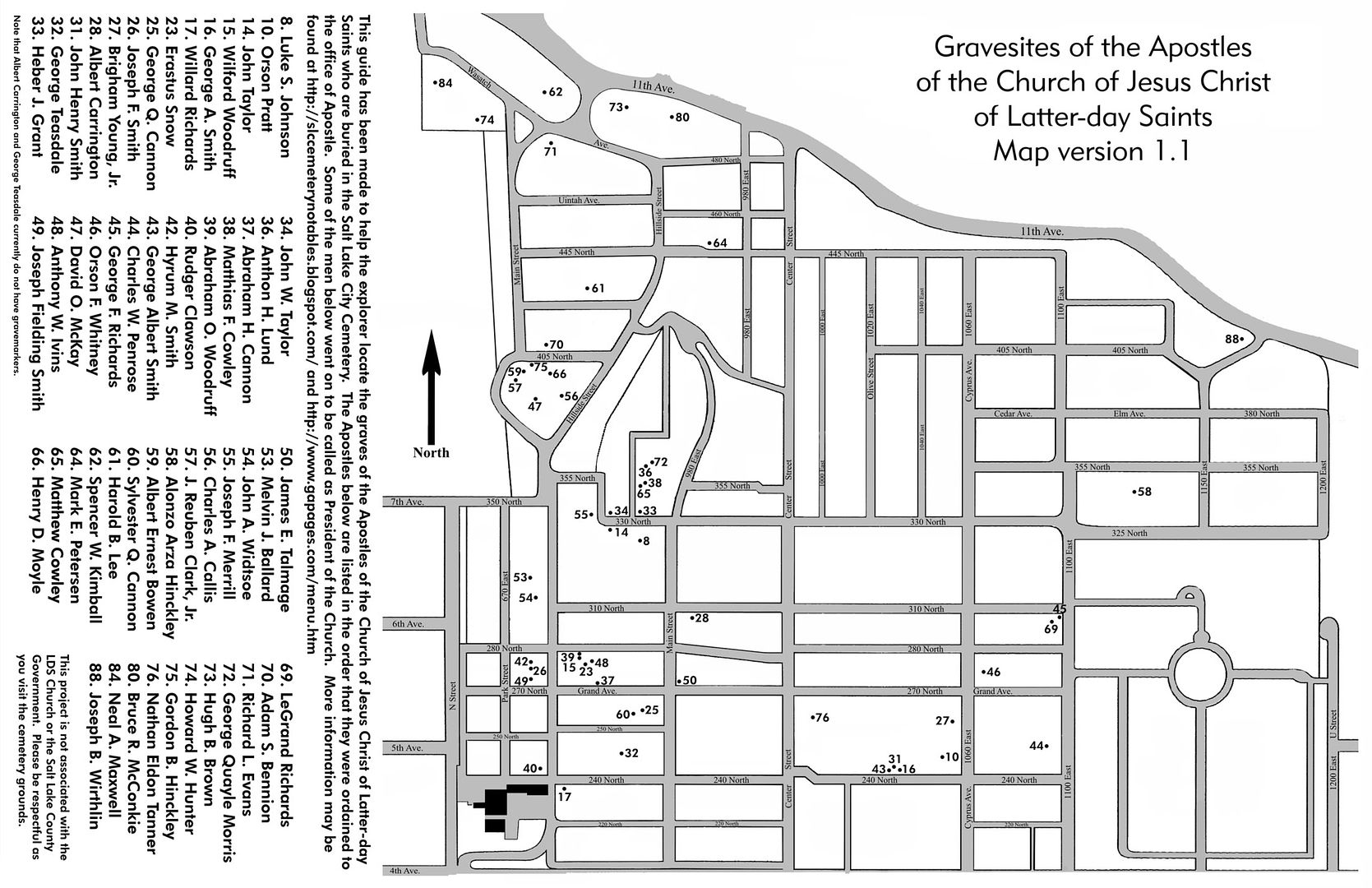
The Map
I have actually had a few requests for this, so this week, I will be finishing the map. Well, at least one of the maps. A comprehensive map of the gravesites of the Apostles of the Church of Jesus Christ of Latter-day Saints, not just the ones that are popular or easy to get to. I've got a very busy Memorial Day coming up, so this map is just the thing to get me in the mindset.
EDIT:
It is done. I have printed a bunch of copies and left them outside the cemetery office if you want a hardcopy. Just go to the east side of the building.
EDIT #2:
I will keep links to my maps in the links to the left so it will always be accessable.
Or click here for a digital copy. I have this map created for printing on legal-sized paper.
Note that this is version 1.1, so changes might be coming along at a later time. Happy hunting!
EDIT:
It is done. I have printed a bunch of copies and left them outside the cemetery office if you want a hardcopy. Just go to the east side of the building.
EDIT #2:
I will keep links to my maps in the links to the left so it will always be accessable.
Or click here for a digital copy. I have this map created for printing on legal-sized paper.
Note that this is version 1.1, so changes might be coming along at a later time. Happy hunting!
Orson F. Whitney
.

Elder Orson F. Whitney seemed destined to serve in LDS Church leadership as he was a grandson of early church leaders Heber C. Kimball and Newel K. Whitney. As a young man of 22 years, Elder Whitney was called on a mission to proclaim the tenets of the LDS Church among the population of Pennsylvania. During his missionary labors, he had a dream where he witnessed the suffering in Gethsemane and crucifixion of Jesus Christ. This dream had a powerful effect on the young man. His discipleship was made sure at this time and he led a life of service to the Church and his fellow man.
As always, a wealth of information can be found at Grandpa Bill's G. A. Pages here.

You can find the monument with this map.
Thanks to my friend Mike S., for helping me originally locating his marker. Mike is a relative of Elder Whitney.
Elder Orson F. Whitney seemed destined to serve in LDS Church leadership as he was a grandson of early church leaders Heber C. Kimball and Newel K. Whitney. As a young man of 22 years, Elder Whitney was called on a mission to proclaim the tenets of the LDS Church among the population of Pennsylvania. During his missionary labors, he had a dream where he witnessed the suffering in Gethsemane and crucifixion of Jesus Christ. This dream had a powerful effect on the young man. His discipleship was made sure at this time and he led a life of service to the Church and his fellow man.
As always, a wealth of information can be found at Grandpa Bill's G. A. Pages here.

You can find the monument with this map.
Thanks to my friend Mike S., for helping me originally locating his marker. Mike is a relative of Elder Whitney.
Sunday, May 10, 2009
Anna Lundahl Johnson
Anna Hansdatter Lundahl Johnson
30 September 1816 - 14 March 1866
Today is Mother's Day and I have a lot of mothers. Aside from the usual Mother's Day activities with my family, I thought I'd remember one of my other mothers. This is a small glimpse of the life of my great-great-great-great-grandmother. I quote from an account of the events from one of her great-granddaughters.
"Twice the Little Swedish Mother and her three daughters had been at the pier ready to board the vessel for America, and twice they had been forced to return to their home by a despotic man who once was the head of the family.
Par Johnson could have been a well respected husband and father, had it not been for the weakness he had for drinking to excess; on those occasions, which were becoming more and more frequent, he was a harsh and cruel companion in the home, bringing only misery and sorrow to the family. Anna Lundahl Johnson, the mother of these three daughters, had put forth to help him to be a better man, but to no avail, until finally she was forced to leave him and sue for a divorce.
The Johnson family lived near Malmo, Sweden; in the latter part of 1849, two Mormon Elders came to the home and when Anna heard the Gospel Message that they brought, she knew in her heart beyond a doubt that she had found the true word of God and soon thereafter she became a members of the Church of Jesus Christ of Latter-day Saints. She opened her doors to the Elders and Saints that they might hold meetings in her home. Par Johnson's anger knew no bounds because of these contacts with the Latter-day Saints; he had no use for the Mormon Elders nor the Church they represented. Par Johnson had no legal right to interfere in their lives; he had forfeited all claim to his family through his own conduct.
In 1855, Christena Johnson, the eldest daughter accepted the Gospel at the age of 13, having been converted by the teachers of Elder Nels Nelson (brother of the man she married a few years later).
Religious persecutions soon began; the Elders were banished or cast into prison, without even as much as a fair hearing; and those people who had befriended the Elders received a like punishment. Because of her kindness to the Mormon Missionaries, Anna Lundahl Johnson was cast into prison, where she was confined for 14 days on a diet of black bread and water. At the end of the 14 day period, her daughters--Christena, Hannah and Caroline (then aged 15, 9, and 5 years respectively) waited outside the prison gate for their mother, not knowing whether she would come to them alive or not, fearful lest her prison treatment might have caused her death. Anna's eyesight was partially impaired because of her long confinement in the dungeon cell; likewise her health was impaired because of her long lack of proper nourishment.
For the third time preparations were under way for a company of Saints to leave for America and Anna and her daughters again began to make their plans. This time they must be sure that Par Johnson did not discover their intentions. Friends helped them--first one of the daughters was taken to Denmark; a short time later, Anna and her youngest daughter, Caroline made their way to Denmark; Christena had been down to the board to see her mother and sister off. On her way back she met her father; of course she was asked what she was doing down there; Christena was employed at a clothing factory and made the excuse of an errand. Her father then asked where her mother was--she couldn't possibly tell him that her mother had gone to Denmark -- he would soon follow the family there, so she was obliged to tell him a falsehood, which troubled her conscience for a long time. She told him that her mother had gone to America--had left the week before. A few days later, Christena and this family of friends joined Anna and her daughters in Denmark. The united family came to America on the sailing vessel "Monarch of the Sea."
Two whole months on the sea, through fair and foul weather. At the end of that long and perilous journey--exhausted and bewildered, they reached the shores of America; their journey led them to Florence, Nebraska, on the Missouri River. Upon arrival at that point, the journey over land across the plains began. And here the Johnson family found themselves like others of the company, without accommodations over and across the long dreary miles to Salt Lake City. So it was that Christena and her mother and two daughters walked the entire distance across the plains, or most of it."
by Meltrude Hunsaker Stohl 1954
Grandmother Anna and her daughters Christena, Hannah and Caroline walked across the plains to the Salt Lake Valley. Anna married a man named Peterson and settled in Sanpete County. She died a few years later and was buried in a paupers lot in the Salt Lake City Cemetery.
I am so grateful to my grandmother Annie and her daughters for suffering hardship and persecution and martyrdom for the faith that they knew was true.

30 September 1816 - 14 March 1866
Today is Mother's Day and I have a lot of mothers. Aside from the usual Mother's Day activities with my family, I thought I'd remember one of my other mothers. This is a small glimpse of the life of my great-great-great-great-grandmother. I quote from an account of the events from one of her great-granddaughters.
"Twice the Little Swedish Mother and her three daughters had been at the pier ready to board the vessel for America, and twice they had been forced to return to their home by a despotic man who once was the head of the family.
Par Johnson could have been a well respected husband and father, had it not been for the weakness he had for drinking to excess; on those occasions, which were becoming more and more frequent, he was a harsh and cruel companion in the home, bringing only misery and sorrow to the family. Anna Lundahl Johnson, the mother of these three daughters, had put forth to help him to be a better man, but to no avail, until finally she was forced to leave him and sue for a divorce.
The Johnson family lived near Malmo, Sweden; in the latter part of 1849, two Mormon Elders came to the home and when Anna heard the Gospel Message that they brought, she knew in her heart beyond a doubt that she had found the true word of God and soon thereafter she became a members of the Church of Jesus Christ of Latter-day Saints. She opened her doors to the Elders and Saints that they might hold meetings in her home. Par Johnson's anger knew no bounds because of these contacts with the Latter-day Saints; he had no use for the Mormon Elders nor the Church they represented. Par Johnson had no legal right to interfere in their lives; he had forfeited all claim to his family through his own conduct.
In 1855, Christena Johnson, the eldest daughter accepted the Gospel at the age of 13, having been converted by the teachers of Elder Nels Nelson (brother of the man she married a few years later).
Religious persecutions soon began; the Elders were banished or cast into prison, without even as much as a fair hearing; and those people who had befriended the Elders received a like punishment. Because of her kindness to the Mormon Missionaries, Anna Lundahl Johnson was cast into prison, where she was confined for 14 days on a diet of black bread and water. At the end of the 14 day period, her daughters--Christena, Hannah and Caroline (then aged 15, 9, and 5 years respectively) waited outside the prison gate for their mother, not knowing whether she would come to them alive or not, fearful lest her prison treatment might have caused her death. Anna's eyesight was partially impaired because of her long confinement in the dungeon cell; likewise her health was impaired because of her long lack of proper nourishment.
For the third time preparations were under way for a company of Saints to leave for America and Anna and her daughters again began to make their plans. This time they must be sure that Par Johnson did not discover their intentions. Friends helped them--first one of the daughters was taken to Denmark; a short time later, Anna and her youngest daughter, Caroline made their way to Denmark; Christena had been down to the board to see her mother and sister off. On her way back she met her father; of course she was asked what she was doing down there; Christena was employed at a clothing factory and made the excuse of an errand. Her father then asked where her mother was--she couldn't possibly tell him that her mother had gone to Denmark -- he would soon follow the family there, so she was obliged to tell him a falsehood, which troubled her conscience for a long time. She told him that her mother had gone to America--had left the week before. A few days later, Christena and this family of friends joined Anna and her daughters in Denmark. The united family came to America on the sailing vessel "Monarch of the Sea."
Two whole months on the sea, through fair and foul weather. At the end of that long and perilous journey--exhausted and bewildered, they reached the shores of America; their journey led them to Florence, Nebraska, on the Missouri River. Upon arrival at that point, the journey over land across the plains began. And here the Johnson family found themselves like others of the company, without accommodations over and across the long dreary miles to Salt Lake City. So it was that Christena and her mother and two daughters walked the entire distance across the plains, or most of it."
by Meltrude Hunsaker Stohl 1954
Grandmother Anna and her daughters Christena, Hannah and Caroline walked across the plains to the Salt Lake Valley. Anna married a man named Peterson and settled in Sanpete County. She died a few years later and was buried in a paupers lot in the Salt Lake City Cemetery.
I am so grateful to my grandmother Annie and her daughters for suffering hardship and persecution and martyrdom for the faith that they knew was true.

Friday, April 10, 2009
The Blog rolls on.
You read that right.
I have the internet up and running again, as well as some insomnia, so I completed my entry for Alexander Neibaur as well as posting an entry for Gordon B. Hinkley.
So you get more now and more to come.

And spring is here so the weather is ideal to get out there and see what you can discover.
I have the internet up and running again, as well as some insomnia, so I completed my entry for Alexander Neibaur as well as posting an entry for Gordon B. Hinkley.
So you get more now and more to come.

And spring is here so the weather is ideal to get out there and see what you can discover.
Subscribe to:
Posts (Atom)